Artificial intelligence is changing how American companies manage operations, serve customers and compete in technology-driven markets. Businesses across industries are investing in generative AI, machine learning, intelligent automation and predictive analytics to improve productivity and accelerate decision-making. However, the growing use of these technologies has created a more important question for business leaders: are AI investments actually improving profitability?
For many organisations, the difficulty is no longer finding an AI tool or testing its capabilities. The challenge is integrating it into existing business systems and generating financial returns that can be measured. A successful demonstration may show that a technology can automate a task, but it does not necessarily prove that the solution can reduce operating costs, increase revenue or deliver sustainable commercial value.
This is pushing companies to reconsider how they evaluate technology investments. Instead of measuring success through the number of AI tools deployed, businesses are increasingly focusing on productivity gains, operational savings, revenue growth and the overall cost of implementation.
Why AI Projects Struggle to Deliver Measurable Business Value
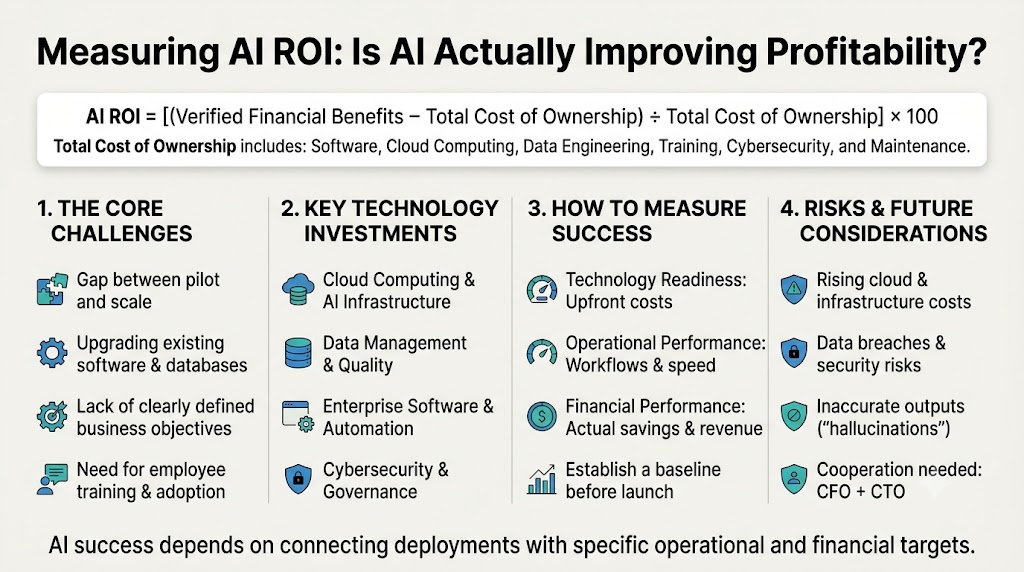
One of the biggest challenges in enterprise AI adoption is the gap between testing and large-scale implementation. A pilot project may work effectively with a small dataset and limited users, but enterprise deployment involves more complex technology requirements.
Existing software platforms may need upgrades, company databases may require restructuring, and employees may need training to work alongside automated systems. Cloud infrastructure, cybersecurity, integration and ongoing maintenance can also increase the total investment.
Another problem is the lack of clearly defined business objectives. Companies sometimes introduce AI because competitors are doing so or because the technology promises greater efficiency. Without identifying the specific business problem, expected financial benefit and responsible project owner, these initiatives can become expensive experiments.
To avoid this, businesses need to connect every AI deployment with a measurable operational or financial target.
The Technology Investments That Influence AI Profitability
The financial performance of an AI project depends on more than the price of software or access to a particular model. Several technology components influence its long-term cost and commercial value.
1. Cloud Computing and AI Infrastructure
AI applications require computing capacity to process information, run models and manage large volumes of data. Cloud platforms allow businesses to access computing resources without building all their infrastructure internally.
However, increasing usage can also raise cloud expenses. Companies must monitor computing consumption, storage requirements and processing costs to ensure that infrastructure spending remains aligned with business demand.
2. Data Management and Integration
Reliable data is essential for effective AI performance. Businesses often need to organise information stored across customer relationship management platforms, enterprise resource planning software, databases and other applications.
Data cleaning, integration and governance can require substantial investment, but poor-quality information can reduce the accuracy and usefulness of AI-generated results. A well-managed data environment helps companies improve automation, reporting and decision-making.
3. Enterprise Software and Workflow Automation
AI is increasingly being integrated into business software used for accounting, customer service, human resources, sales and supply chain management.
These systems can automate repetitive activities, reduce manual processing and improve access to business information. Their value should be measured through actual changes in processing time, operating expenses, service quality and employee productivity.
4. Cybersecurity and AI Governance
As companies connect AI applications with internal systems and sensitive information, security becomes a major investment consideration. Businesses need appropriate access controls, data protection measures, monitoring systems and human oversight.
These expenses may not generate immediate revenue, but they help reduce operational risks and protect customer trust, business information and long-term technology investments.
How US Companies Can Measure AI ROI
Measuring AI ROI requires a structured approach that connects technology performance with financial outcomes. Business leaders should evaluate investments across three stages.
Technology Readiness: Companies first need to understand the investment required to make AI operational. This includes software licences, computing infrastructure, data preparation, system integration and employee training.
Operational Performance: After deployment, businesses should measure whether AI is improving specific workflows. Indicators may include reduced processing time, fewer errors, faster customer responses, improved production output and lower manual workloads.
Financial Performance: The final assessment examines whether operational improvements are translating into measurable financial gains. These may include lower operating expenses, reduced outsourcing costs, additional sales, improved customer retention or higher output without a corresponding increase in resources.
This distinction is important because improved technology performance does not automatically mean improved business profitability.
Calculating the Real Cost of an AI Investment
A reliable AI return-on-investment calculation must include all expenses associated with introducing, operating and maintaining the technology.
AI ROI = [(Verified Financial Benefits − Total Cost of Ownership) ÷ Total Cost of Ownership] × 100
Total cost of ownership should include:
-
AI software subscriptions and licensing fees.
-
Cloud computing, data storage and processing expenses.
-
Data engineering and system integration.
-
Employee training and technical support.
-
Cybersecurity, compliance and monitoring.
-
Maintenance, model updates and human review.
Businesses should also compare results against a baseline established before implementation. Existing labour costs, processing times, error rates and operational expenses provide a reference point for measuring improvements.
For example, if an AI-powered system reduces the time required to process customer requests, the company should examine whether this improvement lowers staffing costs, increases the number of customers served or allows employees to handle more valuable responsibilities.
The distinction between estimated productivity gains and realised financial savings is essential for accurate reporting.
Why CFOs and Technology Leaders Must Work Together
AI profitability is not solely an IT department responsibility. It requires cooperation between Chief Financial Officers, Chief Technology Officers, business managers and operational teams.
Technology leaders understand infrastructure requirements, system performance and implementation challenges. Finance teams assess budgets, operating costs and financial outcomes. Business managers determine whether the technology is solving practical problems within their departments.
When these teams work together, companies can establish realistic investment targets and monitor performance throughout the implementation process.
Regular financial reviews can also help identify projects that are exceeding their budgets or failing to deliver expected results. Instead of continuing to fund underperforming initiatives, businesses can modify the technology, change the implementation strategy or redirect investment towards more commercially valuable applications.
Where AI Can Create New Revenue Opportunities
Although cost reduction is an important reason for adopting AI, its business potential extends beyond operational efficiency.
In retail and e-commerce, AI-powered recommendation systems can help businesses understand customer preferences, personalise offers and improve conversion rates. In manufacturing, predictive maintenance can reduce equipment downtime and support more consistent production. Financial service providers can use machine learning to strengthen fraud detection and improve risk analysis.
Logistics companies can apply predictive analytics to improve route planning, inventory management and delivery operations. Meanwhile, professional service firms can use generative AI to support research, document processing and customer communication.
These applications demonstrate how AI can influence both sides of business performance: controlling expenses and creating opportunities for additional revenue.
For small and medium-sized enterprises, targeted adoption may offer a more practical starting point than large-scale transformation. Automating invoice processing, customer enquiries, inventory tracking or routine reporting can help smaller companies assess financial benefits before committing to wider technology investments.
The Business Risks of Scaling Artificial Intelligence
Expanding AI across an organisation also introduces financial and operational risks. Data breaches, inaccurate outputs, integration failures, regulatory requirements and dependence on technology providers can affect business performance.
Companies must establish clear policies governing how AI systems access information, how automated decisions are reviewed and when human intervention is necessary. They should also monitor system performance regularly and assess whether technology costs remain proportionate to the benefits generated.
Another important consideration is workforce readiness. Employees need appropriate training to use AI tools effectively and understand their limitations. Without sufficient adoption and practical knowledge, even a well-funded technology project may fail to deliver its expected value.
Conclusion
The next stage of artificial intelligence adoption in the United States will be shaped by the ability of companies to convert technological capabilities into measurable commercial results. Businesses that focus only on experimentation may struggle to justify growing technology budgets, while those that connect AI with specific operational and financial objectives will be better positioned to evaluate its value.
From cloud infrastructure and enterprise software to automation and predictive analytics, every AI investment needs a clear business purpose. Accurate cost accounting, reliable performance indicators and collaboration between finance and technology teams can help companies identify which solutions deserve further investment.
Ultimately, the success of AI in the American business sector will depend not on how quickly companies adopt new technology, but on how effectively they use it to improve productivity, strengthen competitiveness and generate sustainable profits.