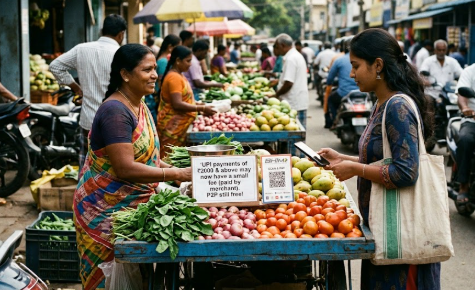
India’s digital payments ecosystem is entering a new phase as a Merchant Discount Rate (MDR) is set to be introduced on certain high-value UPI transactions from October 15, bringing a new cost consideration for businesses while creating a potential revenue stream for banks and payment service providers.
Under the new framework, a 0.4 per cent MDR will apply to eligible person-to-merchant UPI transactions above ₹2,000, with the charge capped at ₹300 for transactions of ₹75,000 and above. The fee will be paid by merchants and cannot be directly passed on to customers.
The change marks a significant shift in the economics of UPI. Since its launch, the platform has played a major role in India's move towards digital payments, allowing consumers and businesses to transfer money instantly through mobile applications and QR codes. The low-cost nature of UPI has helped it become part of everyday transactions, from small shops and street vendors to large businesses.
The new MDR structure is intended to help support the financial sustainability of the payment ecosystem. According to the government, the money will be distributed among payment system participants, including banks, and can support the continued operation, expansion, resilience, innovation and cybersecurity of digital payment infrastructure.
For businesses, however, the change introduces a new operating expense for eligible transactions. Companies that receive a large number of high-value UPI payments may need to review their payment costs and understand how the additional expense affects their margins.
The impact will not be the same for every merchant. Person-to-person UPI payments will remain outside the MDR framework, while merchant payments of up to ₹2,000 will also remain free. The government has said that around 96 per cent of person-to-merchant transactions will remain unaffected, either because they fall below the threshold or are covered under the zero-MDR framework for small merchants.
Certain sectors will follow a separate pricing structure. Eligible UPI merchant payments above ₹2,000 involving areas such as fuel, railways, telecom services, insurance and agricultural inputs will attract a flat ₹5 charge instead of the standard 0.4 per cent MDR.
For the broader business community, the change could encourage greater attention to payment economics. Large retailers and service providers may increasingly compare the cost of different payment channels, while smaller businesses are likely to remain largely protected because most of their transactions fall below the threshold.
The introduction of MDR also raises questions about how businesses will respond to the additional cost. While merchants are not permitted to directly charge customers for the MDR, some businesses could reconsider their payment strategies, discounts or pricing structures to manage higher transaction expenses.
At the same time, payment companies and banks could gain a new source of transaction-linked revenue. A more sustainable revenue model could provide greater scope for investment in payment technology, fraud prevention, cybersecurity, system capacity and merchant services.
The scale of India's UPI network makes the change particularly important. The platform processed a record 24.51 billion transactions worth about ₹29.82 lakh crore in August, highlighting the enormous volume of money moving through the digital payment system.
The introduction of MDR therefore represents more than a new transaction fee. It signals a shift in how India's digital payment infrastructure may be funded as UPI moves from a largely subsidy-supported model towards a system in which some of the costs are linked more directly to high-value commercial transactions.
For businesses, the immediate priority will be understanding which transactions are covered, calculating the potential cost and ensuring that payment systems are ready for the October 15 implementation.
For the payments industry, the bigger question will be whether the new revenue model can support continued investment in India's rapidly expanding digital payment infrastructure without reducing the convenience and acceptance that have made UPI a central part of the country's digital economy.